

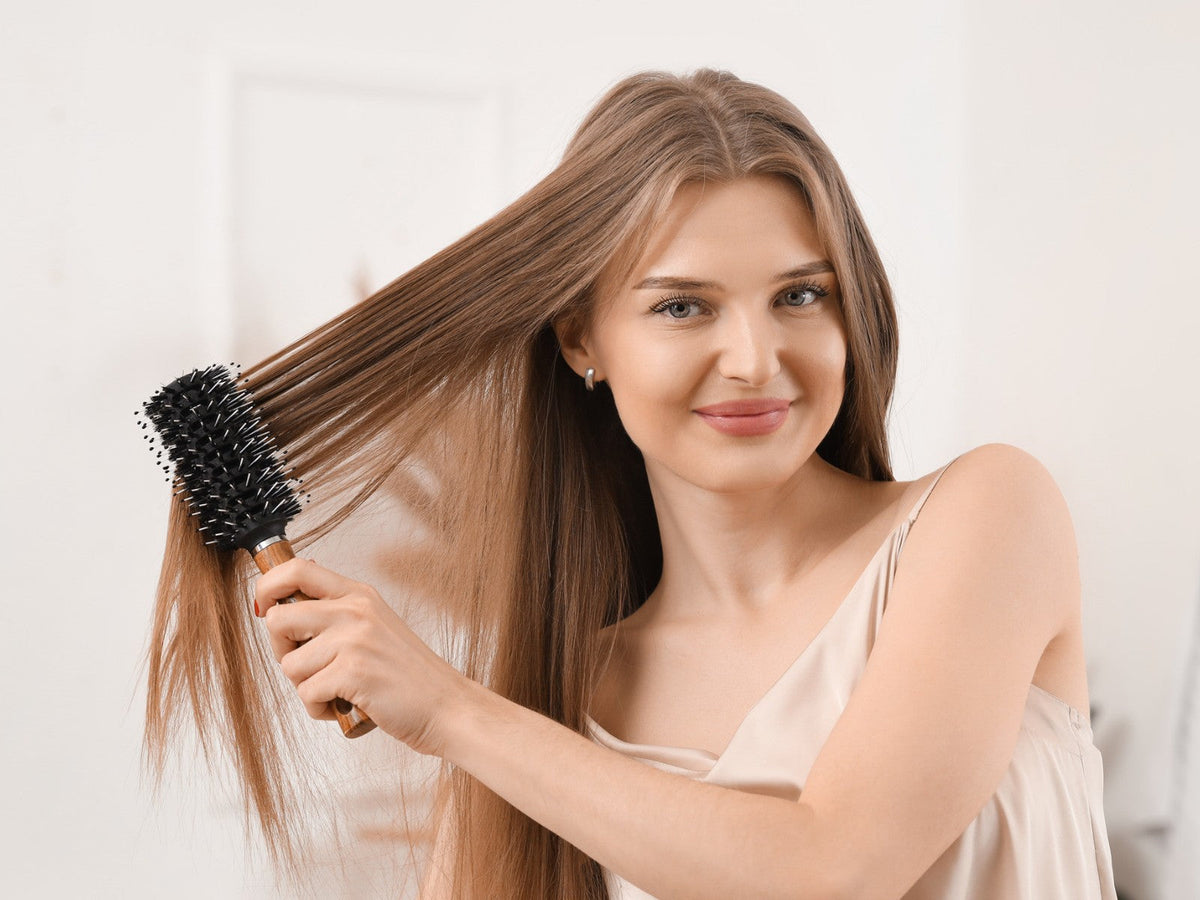
Short answer: Oily roots and dry lengths do not call for one “universal” product from roots to ends. Choose shampoo and an occasional scrub for what your scalp needs, and apply them mainly at the roots. Choose conditioner, mask, or leave-in care for what your lengths need, and keep them from mid-lengths to ends. That is how you build a simple care system that respects both zones at once.
Why these two needs can coexist
Many women describe the same picture: by day two after washing, the roots have already lost their freshness, while the lengths stay dry, dull, or prone to split ends. That is not a contradiction. The scalp and the hair lengths are two different needs.
The scalp produces sebum, sweat, and interacts with styling residue. Lengths are dead keratin fibre — they do not receive hydration and softness “from within” the way living skin does. Washing the roots more often will not, on its own, nourish the lengths. And the reverse is also true: a rich mask at the roots can make lightness feel worse.
At Patéa, we start from that directly: Understand first. Recommend second. First we separate what the scalp needs from what the lengths need. Only then do we build the steps.
Two zones, two questions
Before you reach for another range “for your hair type,” ask yourself two short questions:
- How does the scalp feel between washes? Does it get oily quickly, feel heavy, lose volume at the roots — or is it more sensitive and tight?
- How do the lengths feel? Dry, brittle, colour-treated, fine and easily weighed down — or more resilient?
The answers often differ. That is exactly why it makes sense to combine care across ranges — for example a cleansing step for an oilier scalp and a hydrating or restorative step for the lengths.
How to build your care step by step
1. Cleansing the scalp (not “degreasing at any cost”)
Shampoo belongs primarily on a damp scalp. Work a small amount between your palms, massage with your fingertips (not nails), and let the foam rinse through the lengths. Lengths usually do not need heavy lathering — the foam passing through is enough.
The goal of cleansing oily roots is not to dry the scalp out. The goal is to gently remove excess sebum, sweat, and product residue, and support a feeling of lightness and freshness.
For a scalp that gets oily quickly, loses volume, or feels out of balance, the Scalp Balance range makes sense. Scalp Balance shampoo is designed as a functional yet gentle cleansing step: it helps keep the scalp clean and balanced and supports natural volume from the roots, without aggressive degreasing as the aim.
How often to wash. Let frequency follow the state of your scalp, not a rule of “as little as possible.” For some people, washing every other day is enough; for others, more often. What matters more than the number is whether you feel fresh after washing without tightness — and whether the lengths are not left unnecessarily dry after care.
2. Occasional deeper cleansing before shampoo
If dry shampoo or styling builds up on the scalp, or you feel that your regular shampoo “no longer cleans the way it used to,” a targeted scrub before washing can help.
Scalp Balance Detox Scrub is a pre-wash treatment: fine exfoliating particles from sour cherry shells, kaolin, and refreshing botanical notes (rosemary, mint). It helps remove dead skin cells and residue from the scalp surface and support a feeling of cleanliness and lightness at the roots.
For most scalp types, once a week is enough. With a markedly oily or congested scalp, you can go up to twice a week if needed — always according to how the scalp responds and the product directions. This scrub is not suitable for a very sensitive or irritated scalp.
We cover frequency in more detail in How often should you exfoliate your scalp?.
3. Care for the lengths: hydration, or more intensive support
After cleansing comes the step that belongs in the lengths, not on the scalp.
| State of the lengths | What usually makes sense | Where to apply |
|---|---|---|
| Dry, fine, easily weighed down | A light hydrating conditioner | Mid-lengths to ends |
| Markedly dry, colour-treated, brittle | A richer conditioner or mask | From ear level / mid-lengths down |
| Only the ends are splitting | A smaller amount of care + leave-in | Primarily the ends |
For hydration without unnecessary weight, Hydra Balance conditioner is a fitting choice: light care for lengths that need softness and manageability without losing movement. It can be paired with Scalp Balance shampoo — precisely because the scalp and the lengths have different needs.
If the lengths are markedly dry, stressed, or break easily, consider a more intensive step: Repair Care conditioner for more regular care, or Repair & Protect nourishing mask about 1–2× a week in place of your usual conditioner. The mask helps support the look of softer, more manageable, and more resilient lengths — still only in the zone that needs it.
4. Leave-in care and styling: less, but more precisely
Apply leave-in products and oils sparingly and away from the scalp, unless the product is expressly meant for the scalp. With oilier roots, every unnecessary film at the roots takes away from lightness.
After washing, gently blot hair with a towel (do not rub), detangle from the ends upward, and let the scalp air-dry when the situation allows. Keeping hair in a damp turban for a long time usually does not serve the scalp well.
An example of a simple system (oily roots + dry lengths)
Below is one possible combination. It is not a required set — it is a logic you can adapt to your answers to the two questions above.


Once a week (or as needed):
- Scalp Balance Detox Scrub on a damp scalp → gentle massage → rinse
- Scalp Balance shampoo at the roots
- Hydra Balance conditioner or Repair & Protect mask in the lengths (depending on the state of the hair)
Other washes:
- Scalp Balance shampoo at the roots
- Hydra Balance conditioner (or Repair Care) from mid-lengths down
- Optionally leave-in care only in the lengths / ends
Botanical Intelligence in practice means exactly this: every ingredient and every step has a reason. You do not need to use everything at once. A precise combination for your scalp and your lengths is enough.
How you know the system fits
After two to four weeks of consistent care, watch the quality of how things feel more than a single “perfect” number of days between washes:
- Roots stay fresher longer, without the scalp burning or feeling tight after washing.
- Lengths detangle more easily and split less, without going limp at the roots.
- You need fewer “fix” products (dry shampoo, layered styling) simply because the base care fits better.
- You know which product belongs where — and you are not adding another step “just in case.”
If the roots get oily sooner after a shampoo change and the lengths feel drier, go back to technique: amount, application zone, water temperature, thoroughness of rinsing. Often it is not the wrong product, but a care step that ended too close to the roots, or cleansing that was unnecessarily harsh.
Season, colour, stress, and how often you train can shift needs. That is why it makes sense to retune the system from time to time — not by changing the whole shelf at once, but by adjusting one step according to how the scalp and lengths respond now.
Common mistakes that make the “oily + dry” feeling worse
Conditioner or mask at the roots. Nourishing care at the roots can reduce volume and speed up the feeling of weight. Keep it in the lengths.
Shampoo mainly in the lengths, scalp only “quickly.” Sebum and residue form at the roots. That is where cleansing should be thorough and calm.
Aggressive degreasing. A “squeaky” feeling after washing is not a sign of success. Overly strong cleansing can disrupt scalp comfort and complicate care.
Dry shampoo instead of washing for several days in a row. Occasionally it helps bridge a day. As a long-term substitute for washing, it can add residue on the scalp — and that is when more careful cleansing or a scrub makes sense.
One range “for everything.” If the roots get oily and the lengths are dry, a universal set from roots to ends often misses one of the needs. Combining is fine.
What to expect realistically
With well-built care, you usually notice a shift in comfort more than an “instant transformation”: a longer sense of freshness at the roots, more manageable lengths, easier detangling, less feeling that you are caring “against yourself.” The pace is individual — it depends on wash frequency, styling, colour, weather, and how precisely you apply the products.
Cosmetic care supports how hair and scalp look and feel. It does not replace a medical check when itching, pain, heavy flaking, or other scalp concerns persist.
FAQ
Why do I have oily roots and dry lengths at the same time?
Because the scalp and the hair lengths have different needs. Sebum at the roots does not mean the lengths are hydrated. Washing the roots more often also will not, on its own, nourish the lengths — they need targeted care away from the scalp.
Should I use an oily-hair shampoo on the lengths too?
Focus shampoo on the scalp. Lengths usually clean with the foam as you rinse. Heavy lathering of the lengths can worsen a dry feel, especially on colour-treated or porous hair.
Where exactly should I apply conditioner when I have oily roots?
Roughly from ear level or from mid-lengths to the ends. If fine hair goes limp easily, start even lower and with a smaller amount.
Can I combine Scalp Balance shampoo with Hydra Balance or Repair care?
Yes. Patéa ranges are designed to be combined. Choose shampoo according to the scalp, conditioner or mask according to the lengths. The official product pages expressly support this pairing.
How often should I wash when the roots get oily quickly?
According to the scalp. Notice when an unpleasant feeling of weight or loss of freshness returns. Adjust frequency gradually, and at the same time give the lengths care that protects them from unnecessary drying when you wash more often.
Will a scrub help if I have oily roots?
It can help if you have styling residue, a feeling of a congested scalp, or loss of lightness at the roots. Use it as a step before shampoo and keep frequency moderate. With a sensitive or irritated scalp, choose a different approach.
What if the lengths are fine and I worry about weighing them down?
Choose a lighter conditioner (for example Hydra Balance), a smaller amount, and application further from the roots. Use an intensive mask less often and only on the driest sections.
Summary: care that respects both needs
- Separate the question about the scalp from the question about the lengths.
- Shampoo (and an occasional scrub) — at the roots.
- Conditioner / mask — in the lengths.
- Combine ranges according to real needs, not the name of one set.
- Adjust frequency according to how the scalp responds, not a rigid rule.
Haircare with Soul. begins right here: a few minutes with a clear reason — and a space in which you care not only for your hair, but also for yourself.
Want to build care around your answers? Take the needs diagnostic on pateabotanica.com, or start with Scalp Balance shampoo and Hydra Balance conditioner — we will fine-tune the lengths according to what your hair actually needs.


